






































As a property manager or municipal official, you understand that creating a spectacular holiday display serves a dual purpose — it brings joy to your community while drawing visitors and boosting economic activity. But that same display also introduces liability. On average, about 160 decorating-related injuries occur each day during the holiday season, with falls as the primary cause. When you’re responsible for a commercial property or public space, those numbers take on new weight.
This comprehensive holiday decor safety checklist walks you through every phase of a commercial holiday decoration project, from preinstallation planning through post-season storage. Whether you’re evaluating the scope of an in-house installation or building a case for professional services, this guide helps business owners understand the full range of safety considerations.
Preinstallation Planning and Risk Assessment
For commercial properties, cities, towns, and municipalities, a successful holiday display is a year-round project. Most professional holiday installations are planned and booked between January and July to allow for custom design, fabrication, and scheduling. Your planning process should start no later than the first quarter of the year.
This early planning phase is where safe holiday decoration installation begins. Proper preparation prevents most accidents, ensures budget adherence, maintains aesthetic cohesion, and allows for proper resource allocation. When you identify personnel needs, secure the right-sized aerial lifts, and plan materials management months in advance, you save time and money. More importantly, you create the foundation for a safe project.
Documentation and Team Briefing
Your documentation needs to be comprehensive and ready for review before a single decoration leaves the ground. OSHA requires training and written certification for employees exposed to fall hazards, which includes aspects of commercial holiday decoration installation. Your essential documents include:
- Written safety plan: This document outlines all project safety procedures and must be distributed to every member of your crew for review before work begins.
- Site permits and insurance: Your documentation packet should include current site permits, proof of insurance for personnel involved, and employee training certifications.
- Equipment inspection logs: These daily records confirm that ladders, scaffolding, and aerial lifts have been inspected and found safe for use, in compliance with OSHA standards.
- Emergency action plan: Establish a clear protocol that identifies who calls for help, where the nearest medical facility is located, and how the team communicates if someone is injured or conditions become unsafe.
A mandatory preinstallation safety meeting brings everything together. Gather your entire crew to review procedures, discuss site-specific hazards, and confirm that everyone knows their role in maintaining a safe work environment.
On-Site Hazard Identification
Every installation site presents unique safety challenges. Before work begins, conduct a thorough hazard survey using a detailed checklist:
- Overhead power lines: Identify electrical lines and confirm that work maintains a minimum 10-foot clearance. Contact with electrical lines is one of the most dangerous risks your crew faces.
- Underground utilities: Locate underground utilities before installing any ground-mounted displays or driving stakes for guy wires. Striking electrical, gas, water, or telecommunications lines can cause electrocution, explosions, service disruptions, and costly repairs.
- Ground stability: Assess soil conditions, pavement integrity, and slopes for ladders and aerial lifts. Soft soil, uneven surfaces, or inclines create tipping hazards that can turn routine tasks into catastrophic accidents.
- Traffic control: Plan for pedestrian and vehicle traffic management, especially if you’re working near busy streets or in shopping districts. Designating work zones and using barriers protects both your crew and the public.
Companies that understand the unique challenges of decorating cities and towns know that municipal projects often involve complex site conditions, such as historic buildings with aging facades, crowded downtown areas with limited access, and public spaces where work must happen around regular foot traffic. Professional site assessments account for all of these variables before the first crew member arrives.
Weather Contingency Planning
The weather can shift from manageable to dangerous in minutes. Your team needs a clear protocol for suspending work during high winds, rain, ice, or snow. The plan should explicitly define who has the ultimate authority to make the “stop work” call, like the designated on-site safety supervisor.
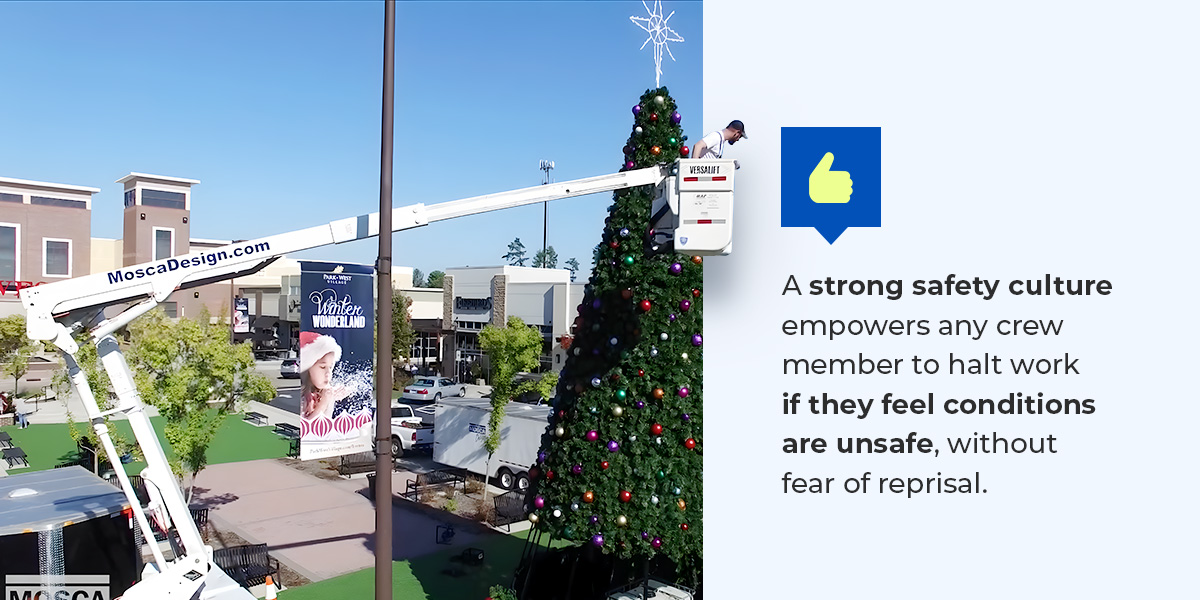
Equally important, a strong safety culture empowers any crew member to halt work if they feel conditions are unsafe, without fear of reprisal. When a worker 30 feet up on a ladder feels wind gusts increasing or notices ice forming on rungs, their judgment matters. Creating an environment where speaking up is encouraged rather than discouraged can be the difference between a safe day and a tragedy.
Holiday Decor Installation Safety Checklist
With planning complete and documentation in place, your crew is ready to begin the hands-on work. This phase introduces the high-risk activities of working at heights, managing electrical systems, and securing heavy decorations against winter weather.
The following checklist breaks down safety requirements by the three primary risk categories every commercial installation faces.
Electrical Safety
Electrical hazards pose serious fire risks during the holiday season, underscoring the importance of electrical safety for holiday decorations. For example, in 2023, electrical malfunctions caused 7,400 nonresidential building fires, resulting in over $354 million in property damage. Christmas light installation safety starts with your equipment and extends through every connection point:
- Inspect for damage. Check every light string and extension cord before use. Common holiday decoration electrical hazards include broken lamp sockets, motor housings, and cracked extension cord covers that may expose electrical conductors to physical damage. Discard and replace damaged sets immediately.
- Use commercial-grade equipment. Look for holiday decorations and electrical components that are tested or certified by an accredited organization and rated for indoor or outdoor use.
- Ensure GFCI protection. Ground Fault Circuit Interrupters (GFCI) detect electrical imbalances and shut off power before someone gets shocked or a fire starts. To increase safety, ensure all power sources are GFCI-protected.
- Keep connections dry. Use weather-resistant covers for outlets and elevate plugs and cord connections off the ground. Snow, standing water, and ice can create dangerous conditions when they come into contact with electrical components.
- Calculate electrical loads. Note the amperage of your displays and the capacity of your power sources to avoid overloading circuits. Careful load calculations can help prevent fires and equipment failures.
- Avoid daisy-chaining. Avoid connecting multiple extension cords in series. Daisy-chaining can increase resistance and poses a fire risk.
- Automate when possible. Use timers or smart controls to reduce strain on your electrical system and conserve energy throughout the holiday season.
Structural Safety
Beautiful decorations lose their appeal quickly when they blow off a building or collapse under wind load. Structural safety focuses on the physical mounting and anchoring systems that keep your display in place throughout the season.
- Use engineer-approved hardware. Use mounting systems designed for your specific building facade. What works for brick may not work for stucco or metal panels. Professional installations often require engineered drawings and load calculations for large displays.
- Do a weight load analysis. Overloading attachment points can cause failures that damage both the decoration and the building. Knowing the combined weight of all decorations at a single mounting point can help prevent damage.
- Implement guy wires and wind resistance. Large displays need proper support systems to handle wind loads. Guy wires, support cables, and reinforcement structures can keep decorations stable during storms.
- Create clear pathways. Eliminate tripping hazards by securing loose wiring, marking changes in elevation, and keeping walkways clear of equipment and materials.
Securing large-scale decorations requires specialized knowledge of structural engineering and building codes. Professional teams bring the expertise to calculate loads, select appropriate hardware, and install displays that remain secure in challenging weather conditions.
Access Safety
Working at height is where the majority of serious injuries occur during commercial holiday decor safety projects. In 2020 alone, there were 161 workplace fatalities and 22,710 injuries from ladders. Roughly 40% of ladder-related injuries stem from the base sliding out due to an incorrect setup angle. These statistics underscore why access equipment safety deserves meticulous attention.

Ladder safety for holiday lights essentials:
- Maintain three points of contact. When climbing, two hands and one foot, or two feet and one hand, should be on the ladder at all times. Avoid carrying materials in your hands while climbing.
- Set extension ladders at a 75-degree angle. The base should be 1 foot away from the wall for every 4 feet of ladder height.
- Ensure the base sits on firm, level ground. Use ladder levelers on uneven surfaces and never place ladders on ice or wet pavement.
- Secure the top of the ladder. Whenever possible, tie off the ladder at the top to prevent side-to-side movement.
Scaffolding best practices:
- Cover the entire work surface with scaffold-grade planks, secured and rated for the load.
- Install guardrails on all open sides and ends of platforms higher than 10 feet, per OSHA scaffolding requirements.
- Set scaffolding on stable, level ground. Use base plates and mud sills to distribute weight.
Aerial lift protocols:
- Check hydraulic systems, emergency controls, outriggers, and platform stability before every use.
- Operators should wear fall protection harnesses with lanyards anchored to the bucket, not the building.
- Only allow authorized personnel to operate aerial lifts. in accordance with OSHA’s standards.
Holiday Display Takedown: Safety Checklist
Takedown carries distinct risks that are often overlooked. Worker fatigue after a long season, deteriorating weather conditions in January and February, and the rush to complete removal quickly all contribute to accidents during this phase. Damaged decorations and property are also common when crews hurry through dismantling.
Safe Dismantling Procedures
Wait for safe weather conditions before beginning takedown work. Ice, snow, and high winds are known to create even more dangerous conditions during removal than they did during installation. Your weather contingency protocols apply here as well.
Follow the reverse order of installation, working systematically from top to bottom and outside to inside. Remember to secure all work areas from public access during overhead work to avoid falling decorations or tools from injuring passersby. A general rule is to use the same access safety protocols during takedown that you followed during installation. The ladder that was safe in November is still governed by the same three-point contact rule in January.
Post-Use Inspection and Inventory
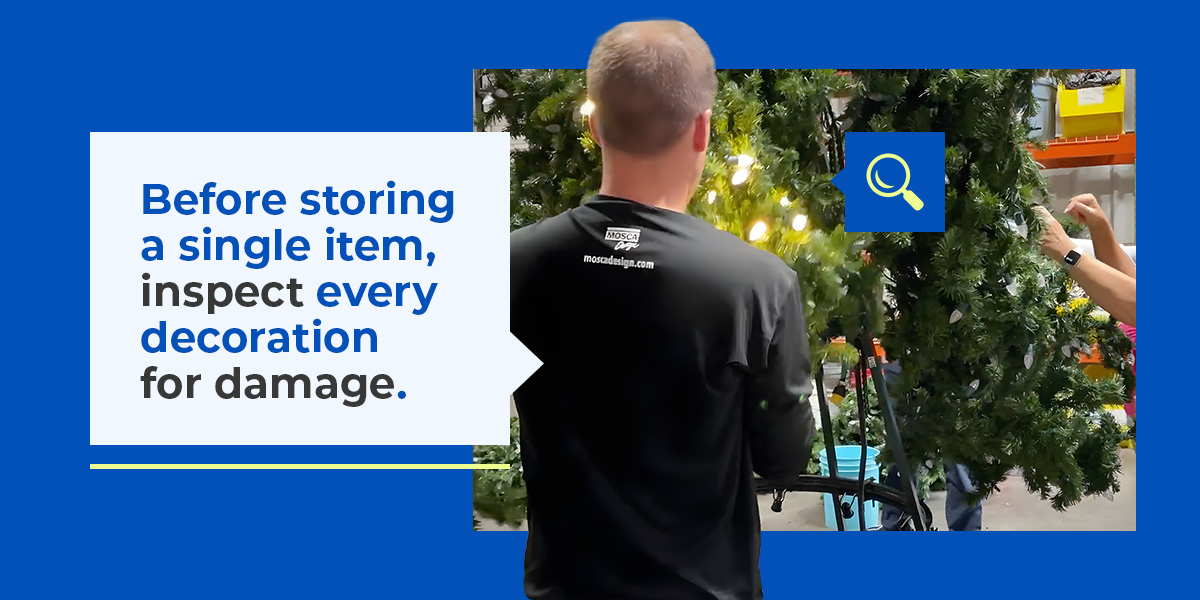
Before storing a single item, inspect every decoration for damage. Look for broken bulbs, cracked plastic, bent frames, damaged electrical components, and missing hardware. Immediately replace or note any needed repairs in writing and tag damaged items so you don’t discover problems when you unpack next season.
Update your inventory logs to reflect what was used, what was damaged, and what you’ll need to replace. This approach should secure your investment and make next year’s planning far more efficient.
Proper Packing and Labeling
Thoughtful packing prevents damage and saves time during next year’s installation. Strategic organization methods protect your investment and streamline future installations.
- Wrap light strings properly. Coil strings gently around spools or cardboard forms to maintain wire integrity and prevent knots that can damage wiring and create safety hazards.
- Use durable containers. When available, store decorations in their original packaging or invest in sturdy, weather-resistant bins designed for long-term storage.
- Protect fragile items. Use bubble wrap, foam inserts, or natural excelsior tucked into containers.
- Label containers. Mark contents and intended installation locations to streamline next season’s setup and eliminate wasted time searching through bins. Color-coded labels or numbered systems further improve efficiency, allowing crews to identify what they need at a glance.
Secure Storage for Longevity
Commercial holiday decorations represent a significant capital investment. The right storage practices ensure your displays look fresh year after year.
- Climate control prevents degradation: Temperature- and humidity-regulated facilities protect fabric displays, LED systems, and painted finishes from degradation. When space is limited, prioritize climate-controlled storage for your most valuable pieces.
- Vertical arrangements save space: Store oversized items like wreaths, garland spools, and dimensional figures upright to prevent crushing and maintain their shape.
- Elevate items off the floor: Use pallets or shelving to protect against flooding and make pest inspections easier throughout the storage period.
If your organization lacks adequate space or climate-controlled options, professional holiday decoration companies may offer secure storage solutions year-round.
Ring in a Safe and Spectacular Holiday Season With MOSCA Design
Creating a holiday display that dazzles your community requires meticulous safety planning, specialized equipment, trained crews, and comprehensive liability management. As this checklist demonstrates, the scope of work extends far beyond hanging lights. From OSHA-compliant documentation and hazard assessments to weather contingencies and climate-controlled storage, each phase carries its own requirements and risks.
MOSCA Design has been transforming commercial spaces into unforgettable holiday experiences for over 40 years. Our full-service solutions remove the entire burden from your shoulders.
Our in-house teams handle every detail — site surveys, custom design, professional installation, post-season dismantling, inspection, and secure storage — so you can focus on enjoying the celebration with your community. Our safe and professional holiday installation service is backed by comprehensive insurance, rigorous safety protocols, and the consultative partnership that has made us a trusted name in commercial holiday decorating.
Ready to create a spectacular display without the liability? Contact us for a consultation and discover how MOSCA Design brings both safety and celebration to your property.

As a property manager or municipal official, you understand that creating a spectacular holiday display serves a dual purpose — it brings joy to your community while drawing visitors and boosting economic activity. But that same display also introduces liability. On average, about 160 decorating-related injuries occur each day during the holiday season, with falls as the primary cause. When you’re responsible for a commercial property or public space, those numbers take on new weight.
This comprehensive holiday decor safety checklist walks you through every phase of a commercial holiday decoration project, from preinstallation planning through post-season storage. Whether you’re evaluating the scope of an in-house installation or building a case for professional services, this guide helps business owners understand the full range of safety considerations.
Preinstallation Planning and Risk Assessment
For commercial properties, cities, towns, and municipalities, a successful holiday display is a year-round project. Most professional holiday installations are planned and booked between January and July to allow for custom design, fabrication, and scheduling. Your planning process should start no later than the first quarter of the year.
This early planning phase is where safe holiday decoration installation begins. Proper preparation prevents most accidents, ensures budget adherence, maintains aesthetic cohesion, and allows for proper resource allocation. When you identify personnel needs, secure the right-sized aerial lifts, and plan materials management months in advance, you save time and money. More importantly, you create the foundation for a safe project.
Documentation and Team Briefing
Your documentation needs to be comprehensive and ready for review before a single decoration leaves the ground. OSHA requires training and written certification for employees exposed to fall hazards, which includes aspects of commercial holiday decoration installation. Your essential documents include:
- Written safety plan: This document outlines all project safety procedures and must be distributed to every member of your crew for review before work begins.
- Site permits and insurance: Your documentation packet should include current site permits, proof of insurance for personnel involved, and employee training certifications.
- Equipment inspection logs: These daily records confirm that ladders, scaffolding, and aerial lifts have been inspected and found safe for use, in compliance with OSHA standards.
- Emergency action plan: Establish a clear protocol that identifies who calls for help, where the nearest medical facility is located, and how the team communicates if someone is injured or conditions become unsafe.
A mandatory preinstallation safety meeting brings everything together. Gather your entire crew to review procedures, discuss site-specific hazards, and confirm that everyone knows their role in maintaining a safe work environment.
On-Site Hazard Identification
Every installation site presents unique safety challenges. Before work begins, conduct a thorough hazard survey using a detailed checklist:
- Overhead power lines: Identify electrical lines and confirm that work maintains a minimum 10-foot clearance. Contact with electrical lines is one of the most dangerous risks your crew faces.
- Underground utilities: Locate underground utilities before installing any ground-mounted displays or driving stakes for guy wires. Striking electrical, gas, water, or telecommunications lines can cause electrocution, explosions, service disruptions, and costly repairs.
- Ground stability: Assess soil conditions, pavement integrity, and slopes for ladders and aerial lifts. Soft soil, uneven surfaces, or inclines create tipping hazards that can turn routine tasks into catastrophic accidents.
- Traffic control: Plan for pedestrian and vehicle traffic management, especially if you’re working near busy streets or in shopping districts. Designating work zones and using barriers protects both your crew and the public.
Companies that understand the unique challenges of decorating cities and towns know that municipal projects often involve complex site conditions, such as historic buildings with aging facades, crowded downtown areas with limited access, and public spaces where work must happen around regular foot traffic. Professional site assessments account for all of these variables before the first crew member arrives.
Weather Contingency Planning
The weather can shift from manageable to dangerous in minutes. Your team needs a clear protocol for suspending work during high winds, rain, ice, or snow. The plan should explicitly define who has the ultimate authority to make the “stop work” call, like the designated on-site safety supervisor.
Equally important, a strong safety culture empowers any crew member to halt work if they feel conditions are unsafe, without fear of reprisal. When a worker 30 feet up on a ladder feels wind gusts increasing or notices ice forming on rungs, their judgment matters. Creating an environment where speaking up is encouraged rather than discouraged can be the difference between a safe day and a tragedy.
Holiday Decor Installation Safety Checklist
With planning complete and documentation in place, your crew is ready to begin the hands-on work. This phase introduces the high-risk activities of working at heights, managing electrical systems, and securing heavy decorations against winter weather.
The following checklist breaks down safety requirements by the three primary risk categories every commercial installation faces.
Electrical Safety
Electrical hazards pose serious fire risks during the holiday season, underscoring the importance of electrical safety for holiday decorations. For example, in 2023, electrical malfunctions caused 7,400 nonresidential building fires, resulting in over $354 million in property damage. Christmas light installation safety starts with your equipment and extends through every connection point:
- Inspect for damage. Check every light string and extension cord before use. Common holiday decoration electrical hazards include broken lamp sockets, motor housings, and cracked extension cord covers that may expose electrical conductors to physical damage. Discard and replace damaged sets immediately.
- Use commercial-grade equipment. Look for holiday decorations and electrical components that are tested or certified by an accredited organization and rated for indoor or outdoor use.
- Ensure GFCI protection. Ground Fault Circuit Interrupters (GFCI) detect electrical imbalances and shut off power before someone gets shocked or a fire starts. To increase safety, ensure all power sources are GFCI-protected.
- Keep connections dry. Use weather-resistant covers for outlets and elevate plugs and cord connections off the ground. Snow, standing water, and ice can create dangerous conditions when they come into contact with electrical components.
- Calculate electrical loads. Note the amperage of your displays and the capacity of your power sources to avoid overloading circuits. Careful load calculations can help prevent fires and equipment failures.
- Avoid daisy-chaining. Avoid connecting multiple extension cords in series. Daisy-chaining can increase resistance and poses a fire risk.
- Automate when possible. Use timers or smart controls to reduce strain on your electrical system and conserve energy throughout the holiday season.
Structural Safety
Beautiful decorations lose their appeal quickly when they blow off a building or collapse under wind load. Structural safety focuses on the physical mounting and anchoring systems that keep your display in place throughout the season.
- Use engineer-approved hardware. Use mounting systems designed for your specific building facade. What works for brick may not work for stucco or metal panels. Professional installations often require engineered drawings and load calculations for large displays.
- Do a weight load analysis. Overloading attachment points can cause failures that damage both the decoration and the building. Knowing the combined weight of all decorations at a single mounting point can help prevent damage.
- Implement guy wires and wind resistance. Large displays need proper support systems to handle wind loads. Guy wires, support cables, and reinforcement structures can keep decorations stable during storms.
- Create clear pathways. Eliminate tripping hazards by securing loose wiring, marking changes in elevation, and keeping walkways clear of equipment and materials.
Securing large-scale decorations requires specialized knowledge of structural engineering and building codes. Professional teams bring the expertise to calculate loads, select appropriate hardware, and install displays that remain secure in challenging weather conditions.
Access Safety
Working at height is where the majority of serious injuries occur during commercial holiday decor safety projects. In 2020 alone, there were 161 workplace fatalities and 22,710 injuries from ladders. Roughly 40% of ladder-related injuries stem from the base sliding out due to an incorrect setup angle. These statistics underscore why access equipment safety deserves meticulous attention.
Ladder safety for holiday lights essentials:
- Maintain three points of contact. When climbing, two hands and one foot, or two feet and one hand, should be on the ladder at all times. Avoid carrying materials in your hands while climbing.
- Set extension ladders at a 75-degree angle. The base should be 1 foot away from the wall for every 4 feet of ladder height.
- Ensure the base sits on firm, level ground. Use ladder levelers on uneven surfaces and never place ladders on ice or wet pavement.
- Secure the top of the ladder. Whenever possible, tie off the ladder at the top to prevent side-to-side movement.
Scaffolding best practices:
- Cover the entire work surface with scaffold-grade planks, secured and rated for the load.
- Install guardrails on all open sides and ends of platforms higher than 10 feet, per OSHA scaffolding requirements.
- Set scaffolding on stable, level ground. Use base plates and mud sills to distribute weight.
Aerial lift protocols:
- Check hydraulic systems, emergency controls, outriggers, and platform stability before every use.
- Operators should wear fall protection harnesses with lanyards anchored to the bucket, not the building.
- Only allow authorized personnel to operate aerial lifts. in accordance with OSHA’s standards.
Holiday Display Takedown: Safety Checklist
Takedown carries distinct risks that are often overlooked. Worker fatigue after a long season, deteriorating weather conditions in January and February, and the rush to complete removal quickly all contribute to accidents during this phase. Damaged decorations and property are also common when crews hurry through dismantling.
Safe Dismantling Procedures
Wait for safe weather conditions before beginning takedown work. Ice, snow, and high winds are known to create even more dangerous conditions during removal than they did during installation. Your weather contingency protocols apply here as well.
Follow the reverse order of installation, working systematically from top to bottom and outside to inside. Remember to secure all work areas from public access during overhead work to avoid falling decorations or tools from injuring passersby. A general rule is to use the same access safety protocols during takedown that you followed during installation. The ladder that was safe in November is still governed by the same three-point contact rule in January.
Post-Use Inspection and Inventory
Before storing a single item, inspect every decoration for damage. Look for broken bulbs, cracked plastic, bent frames, damaged electrical components, and missing hardware. Immediately replace or note any needed repairs in writing and tag damaged items so you don’t discover problems when you unpack next season.
Update your inventory logs to reflect what was used, what was damaged, and what you’ll need to replace. This approach should secure your investment and make next year’s planning far more efficient.
Proper Packing and Labeling
Thoughtful packing prevents damage and saves time during next year’s installation. Strategic organization methods protect your investment and streamline future installations.
- Wrap light strings properly. Coil strings gently around spools or cardboard forms to maintain wire integrity and prevent knots that can damage wiring and create safety hazards.
- Use durable containers. When available, store decorations in their original packaging or invest in sturdy, weather-resistant bins designed for long-term storage.
- Protect fragile items. Use bubble wrap, foam inserts, or natural excelsior tucked into containers.
- Label containers. Mark contents and intended installation locations to streamline next season’s setup and eliminate wasted time searching through bins. Color-coded labels or numbered systems further improve efficiency, allowing crews to identify what they need at a glance.
Secure Storage for Longevity
Commercial holiday decorations represent a significant capital investment. The right storage practices ensure your displays look fresh year after year.
- Climate control prevents degradation: Temperature- and humidity-regulated facilities protect fabric displays, LED systems, and painted finishes from degradation. When space is limited, prioritize climate-controlled storage for your most valuable pieces.
- Vertical arrangements save space: Store oversized items like wreaths, garland spools, and dimensional figures upright to prevent crushing and maintain their shape.
- Elevate items off the floor: Use pallets or shelving to protect against flooding and make pest inspections easier throughout the storage period.
If your organization lacks adequate space or climate-controlled options, professional holiday decoration companies may offer secure storage solutions year-round.
Ring in a Safe and Spectacular Holiday Season With MOSCA Design
Creating a holiday display that dazzles your community requires meticulous safety planning, specialized equipment, trained crews, and comprehensive liability management. As this checklist demonstrates, the scope of work extends far beyond hanging lights. From OSHA-compliant documentation and hazard assessments to weather contingencies and climate-controlled storage, each phase carries its own requirements and risks.
MOSCA Design has been transforming commercial spaces into unforgettable holiday experiences for over 40 years. Our full-service solutions remove the entire burden from your shoulders.
Our in-house teams handle every detail — site surveys, custom design, professional installation, post-season dismantling, inspection, and secure storage — so you can focus on enjoying the celebration with your community. Our safe and professional holiday installation service is backed by comprehensive insurance, rigorous safety protocols, and the consultative partnership that has made us a trusted name in commercial holiday decorating.
Ready to create a spectacular display without the liability? Contact us for a consultation and discover how MOSCA Design brings both safety and celebration to your property.